A pond that evolves without you.

Tiny creatures built from cells swim, graze, breed and evolve on their own, while tardigrades hunt them. Lend a hand, or just watch a little world find its way.

Free. No ads, no accounts, no data collected. Mac, Windows, Linux, and any modern browser.
Play now

Right here. No install.

Tap to add a beast, plant algae, drop a mud island, and see who survives. Your pond is saved in your browser.

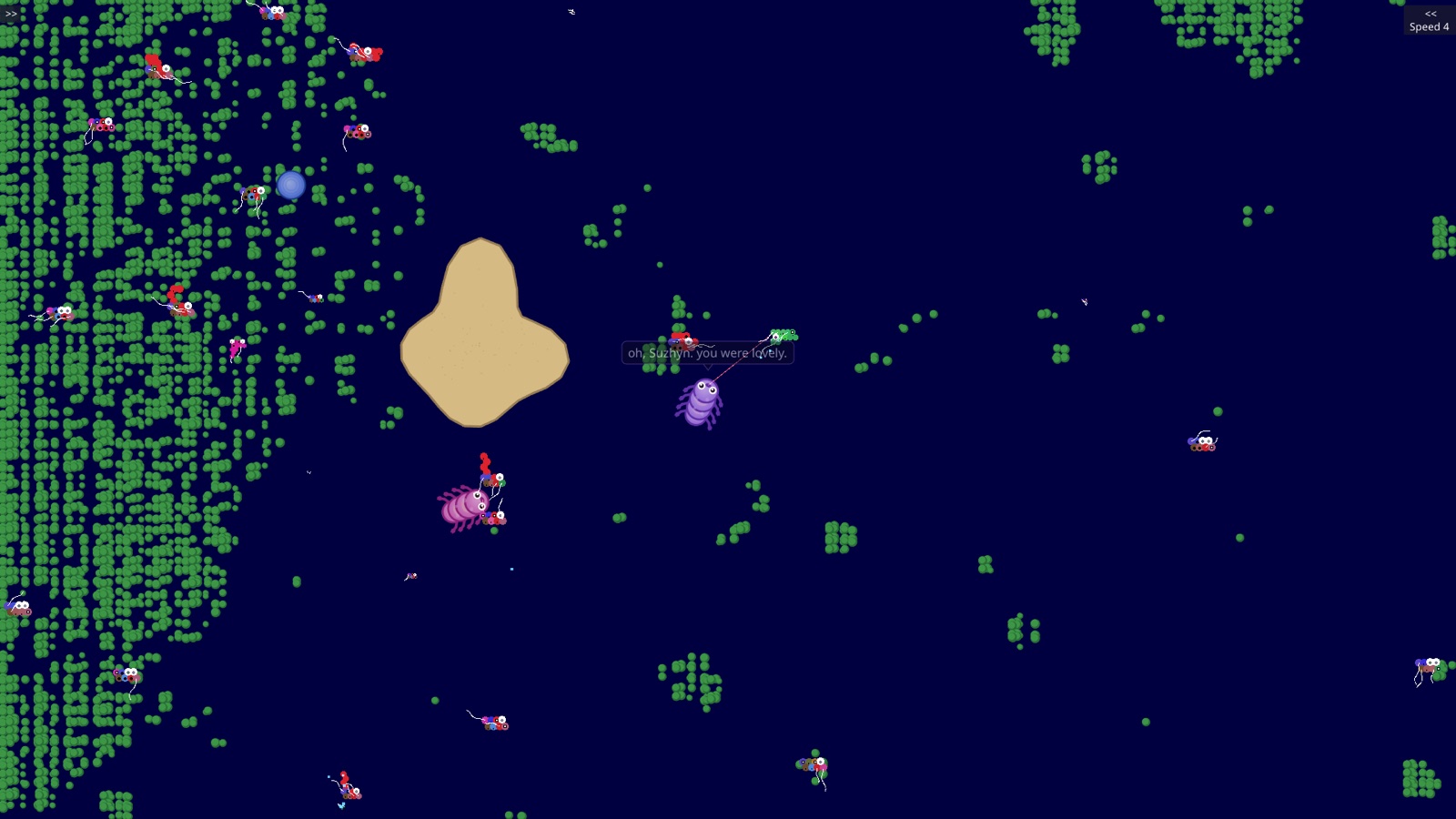
A Beasts pond: algae, beasts and a tardigrade
Works with a mouse or by touch. On a phone, turn it sideways. Open full screen ↗
Live on YouTube, now and then

Play along from the chat.

Now and then the pond streams live on YouTube. While it does, type a command in the chat and it happens on screen, for everyone watching.

!beastAdd a beast
!food C4Plant algae on the grid
!name BobName a beast
!swarmStart a panic
!predatorRelease a hunter

A name filter keeps the stream clean, even when nobody's watching.

Beasts grazing on algae
Evolution

Nobody designed these.

Beasts are made of cells: eyes that spot food, legs that swim, mouths that eat, brains, and breeders that grow new cells. When two grown beasts meet, their child mixes both bodies, with the odd mutation. Families rise and fall, and the pond fills with shapes nobody planned.

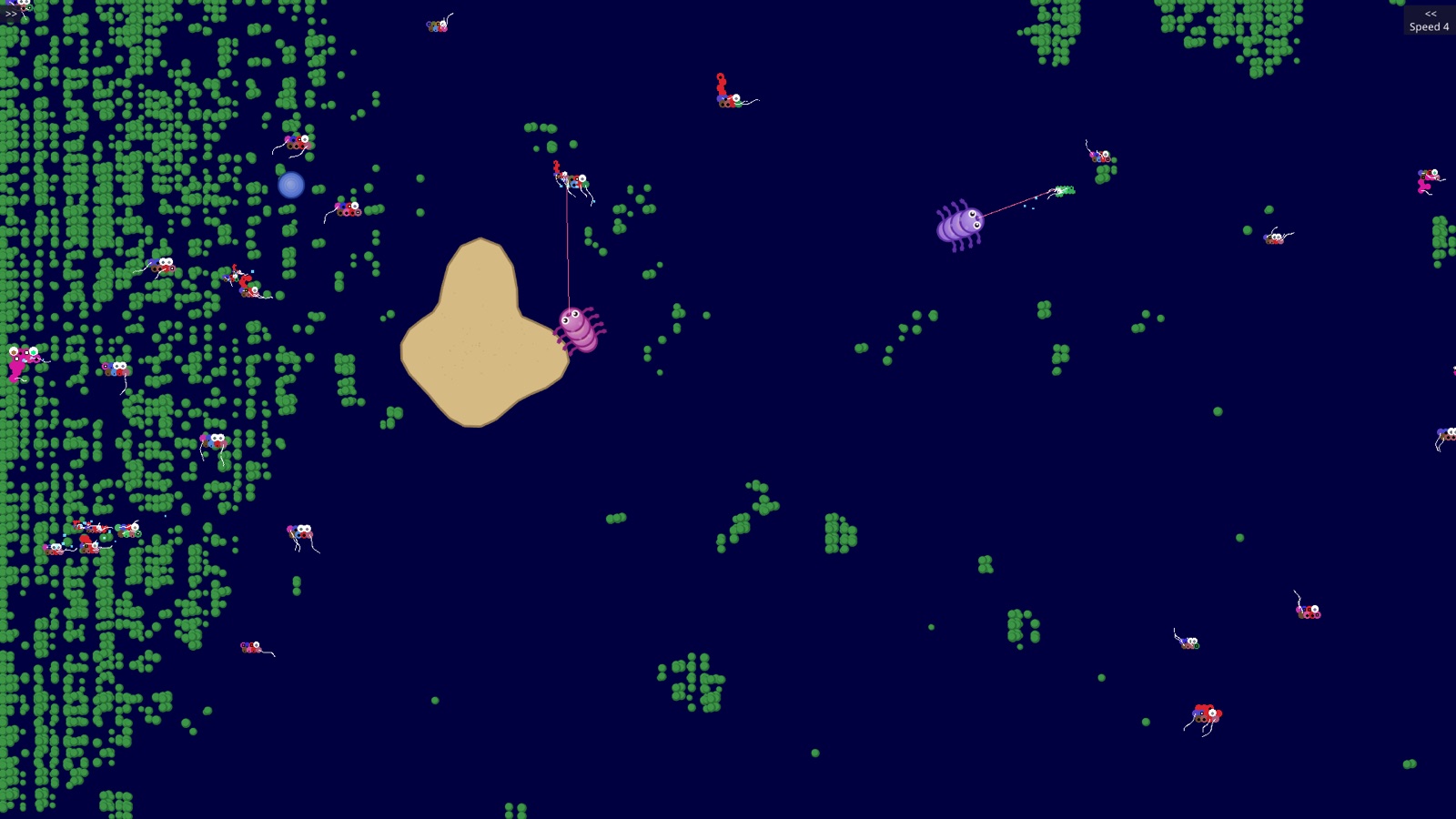
A swarm of beasts fleeing a tardigrade
Predators

Hunters in the water.

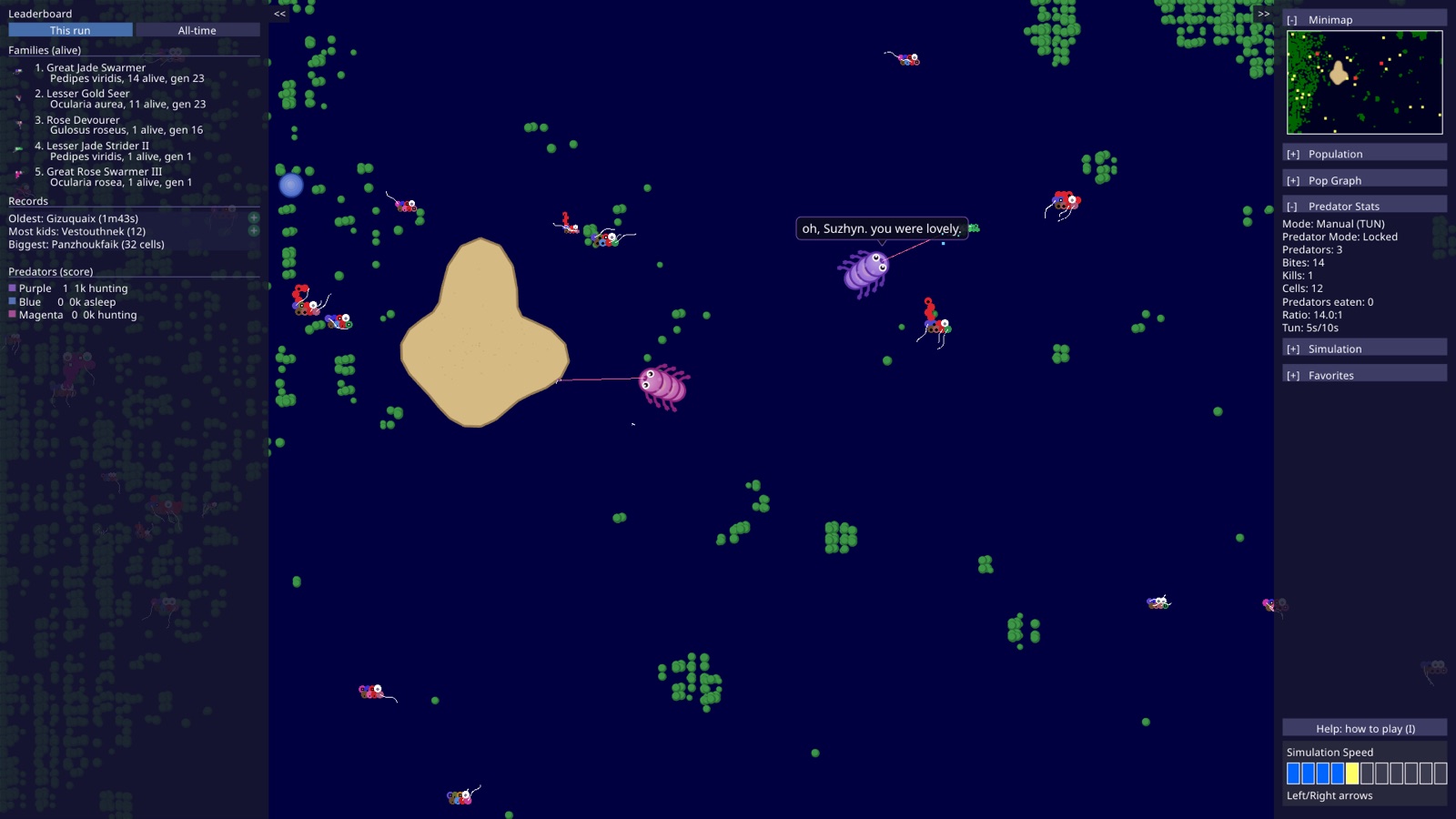
Tardigrades hunt the beasts. Steer one yourself or let it hunt alone, and add up to eight. Starving hunters curl up into a dormant tun, and then the others eat them. Some beasts swarm: a dense flock confuses the hunters, so loners get eaten first.

The beast designer
Designer

Build a beast, cell by cell.

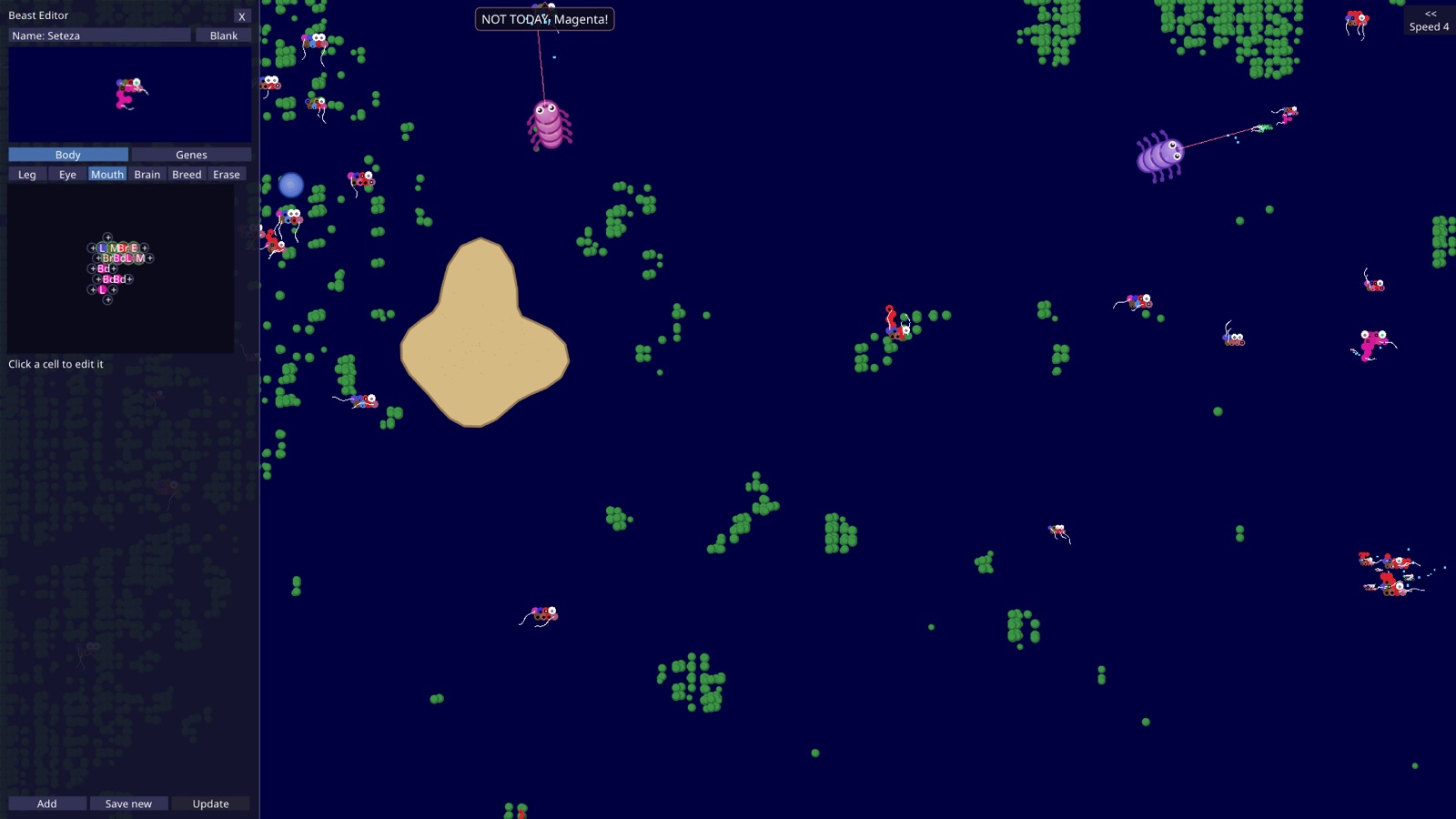
Design your own creature in the editor and release it into the pond. Keep your favorites: they join every new world. Will your design found a dynasty, or feed the tardigrades?

The leaderboard and side panel
Stories

A world that talks back.

Beasts and predators chatter about what's happening to them. Highlights call out feeding frenzies, population booms and new generations. The leaderboard keeps the biggest families, the oldest beasts and the top hunters, run after run.

Lend a hand, or don't

Five ways to meddle.

Plant algaeFeed the pond and watch it spread.
Drop mud islandsSplit a population and see what happens.
Design beastsCell by cell, then let them loose.
Keep favoritesThey join every new world.
Bend timeSpeed it up, slow it down, pause and inspect.
Free download

Take the pond home.

The browser version is a taste. The desktop game is a pond to keep: leave it running all day, let it grow bigger, and keep every world you make.

Bigger, livelier ponds It runs natively on your computer, so the pond holds more beasts before it has to thin them out.
Leave it running Its own window or full screen, on a spare monitor or in the corner all day. No internet needed.
Saves that last Worlds, favorites and the all-time leaderboard are files on your computer, safe from browser clean-ups and easy to back up.
Stream your own pond Go live on your YouTube channel and let your viewers feed, name and hunt your beasts from the chat.

macOS

macOS 13 or later, Apple Silicon or Intel. Signed and notarized by Apple. 33 MB.
Download for Mac

Windows

Windows 10 or later, 64-bit. 18 MB. If SmartScreen warns you, choose More info, then Run anyway.
Download for Windows

Linux

64-bit, any recent distribution, OpenGL 3.2. Runs on Steam Deck too.
Download for Linux
Coming to Steam, free. Wishlisting opens soon.
Questions

Good to know.

Looking for how to play? See the full help guide.

Is it really free?

Yes. No ads, no purchases, no accounts. Just the pond.

Does it collect any data?

No. The game has no accounts and sends nothing anywhere. The browser version keeps your saves in your own browser. Streaming to YouTube is opt-in and uses your own YouTube account.

Can I play on my phone or iPad?

Yes, in the browser. Hold your phone sideways. On an iPhone, use Share, then Add to Home Screen, and it opens full screen like an app.

Is the evolution real?

Nothing is scripted. Beasts that find food grow and breed. Children mix their parents' cells, with mutations. Predators eat the slow and the alone. What survives is up to the pond, and to you.

Was AI used to make it?

Beasts was built by Andrew R. Harding and was inspired by a conversation with an engineer and mathematician named Simon. Simon wrote an earlier version in Java in the early 2000s. This update was built with some help from a software development agent.

Where does the idea come from?

Andrew was down a rabbit hole researching DIY electronic pets when he found a post from Simon. The two got talking about biosimulation games, and Simon dug out his Java applet from the early 2000s. Andrew rewrote it as an exercise to learn Go. For years since, the beasts have lived in a little pond in Andrew's office, swimming and munching algae, with hardly anyone watching. They're hungry for a little care and feeding.

How do I get in touch?

Email apps@marmonte.ai, or message Andrew on LinkedIn or X. Ideas, bugs and pictures of your favorite beasts are all welcome. Follow along on GitHub for updates, and on YouTube for live streams.